
So it’s been about a year since Raj and I started Fulton Ring. It’s our consulting firm focused on building “Intelligence Fabrics” - systems for enterprises to autonomously organize and analyze their data.
We’ve shipped/are in the process of shipping 6 projects. We were in the news. We became LinkedIn famous. By most measures, year one was a success.
But here’s what actually happened: we spent seven months building a product for a market with only a handful of potential customers, had a month-long existential crisis, and came out the other side with a completely different outlook on how startup operators should evaluate their ideas.
This is that story.
The FEMA Moment
In February, only a few months after starting the business, we were asked to preserve FEMA’s Future Risk Index before it was taken down by the Trump administration. After releasing it, we immediately got a ton of inbound:
“Are you going to keep updating the data?”
“Can you make this available at the parcel level? We don’t care about county-level data.”
These were tall asks. Neither of us had a climate science background. We didn’t want to deploy buoys in the ocean or collect temperature readings for every square foot of the United States. That would be really hard.
But there was a problem we’d run into while building the Future Risk Index: making maps and explaining climate impacts was a massive pain in the ass. So we thought, “what if we could make that easier?”
Over spring and summer, we built Marauders - an AI-powered map-making tool for spatial analysis. We hosted an adaptation and resilience themed hackathon during Climate Week to test it with real users working solutions for air quality, extreme heat, and flooding.
And we watched.
The Feedback
The week after the hackathon was also our first week at Antler, a startup incubator in New York. We took a day off to recover after the hackathon, so our first day of the residency was also our first time to debrief.
The feedback was... mixed:
People liked being able to analyze data quickly
People expected way more pre-loaded datasets. Most of their time was spent tracking down data and wrestling it into Marauders
The AI map-making features didn’t help anyone. Turns out, you can vibe-code a map in about the same amount of time
And when we looked at who might actually pay for this? The only players at the intersection of climate and geospatial tech with money were insurance companies.
So we went to the partners and spilled all our thoughts on the table.
The Insurance Rabbit Hole
We were introduced to other founders in the insurance world. It turns out, property insurance companies aren’t really tech companies. Their moat is their ability to navigate regulatory bullshit and not die. Most don’t build tech that they don’t have to. Instead, they rely on data brokers like Corelogic, Vexcel, e2value, or Verisk, who do the heavy lifting. Those brokers might do some enrichment (like detecting property features from aerial imagery) before insurance companies turn these into premiums with models that have been vetted by the state.
We thought: “What if we could save them money on that enrichment step?” If a company is spending $100k on feature detection, we could build pre-trained models to slash those costs. Lots of upside there, right?
We went back to the partners to gut-check the idea.
“Who are you gonna sell this to?”
“Insurance companies. Maybe climate-focused hedge funds too.”
“Okay. How many companies need this?”
We struggled to get past four.
VC Math
Here’s the thing you need to know about venture capital: They aren’t looking to sell your company for a few million dollars. That’s some PE shit.
VC is like going to the casino, putting it all on black at the roulette wheel 100 times, and hoping that one of those spins makes 1000x your initial investment. It is like playing the lottery with slightly better odds. They need you to at least have the potential to become a billion-dollar company so that they can make more money than they lost when 99% of their other investments go to zero1.
If we assume a software company can exit for 10x their revenue, a billion-dollar company needs to make about $100 million in revenue every year. There’s a few paths they can take to get there:
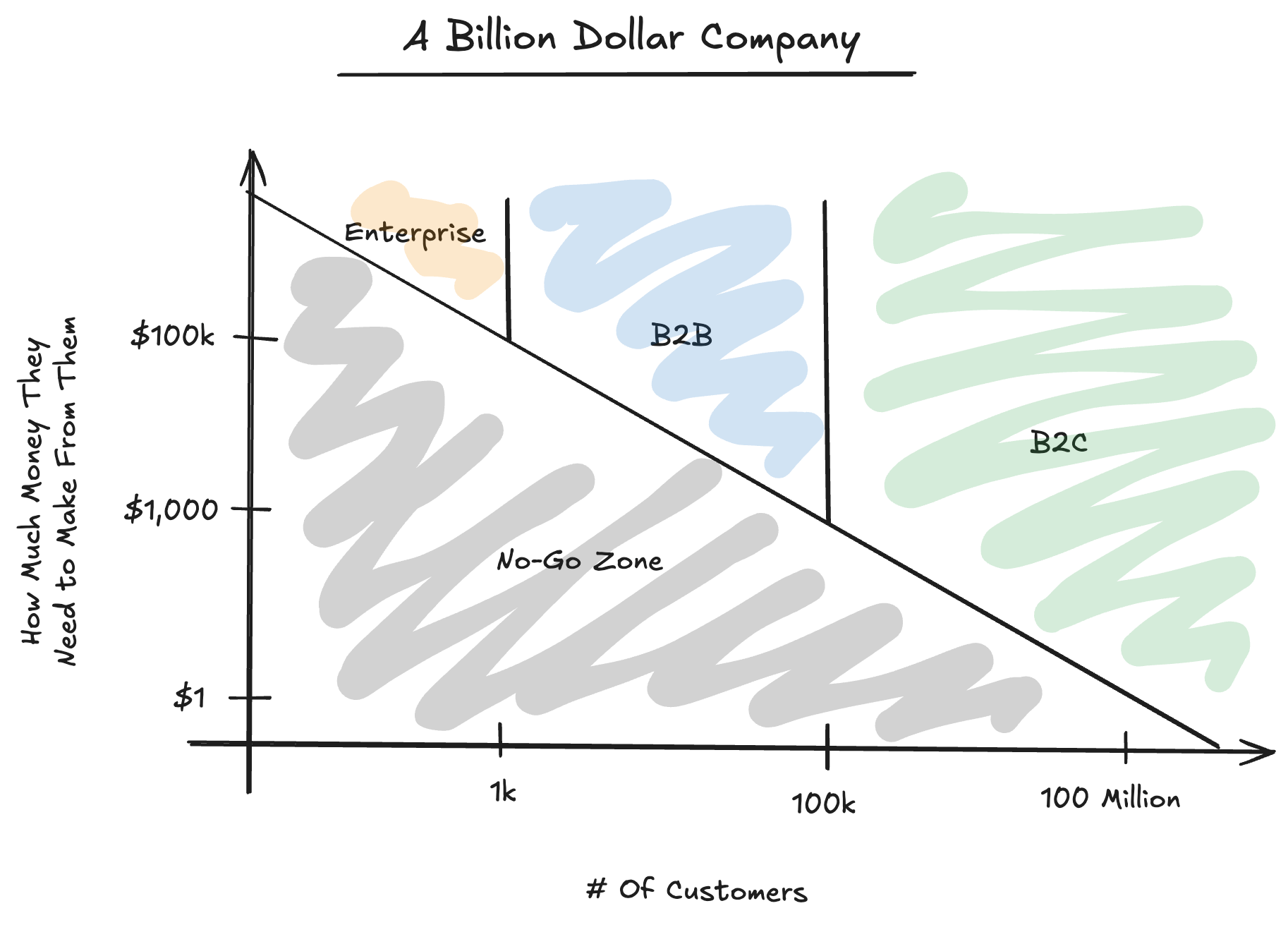
Enterprise: Selling something really specialized to a handful of customers for a $100k+ every year.
B2B: Selling something super general for tens of thousands of businesses for about $10-100 every month.
B2C: Having millions of users and indirectly profiting from each one (usually through data or ads).
All of our ideas had been in the no-go zone. Too small of a market for too little revenue. We were about to pivot to becoming another lifestyle company.
Thinking Bigger
Raj came back the next day with the realization: “We should just become the insurance company”
“That’s fucking crazy,” I said. “We have absolutely no qualifications to start an insurance company”
And then I started agreeing with him.
I told my parents this idea. They thought we’d completely lost our minds.
On the surface, it is crazy. Every insurance company you’ve ever dealt with is a massive, evil megacorp. But after talking to other industry professionals, we learned that it’s actually not that unreasonable to start a small agency. We would just need the patience to go through acquiring tons of licensing and a boatload of money. And that was indeed outside of what our runway and skillsets would allow.
Saying it out loud made us realize what the stakes were. We weren’t thinking big enough.
We’d been trying to optimize little pieces of other people’s value chains. Save an insurance company $50k on feature detection. Shave some hours off someone’s map-making workflow. These were real problems, sure, but they were small problems. Instead of trying to fight to sell a little piece of software to a handful of huge customers, we should just become that customer.
For the past decade, standard startup doctrine has been to find a small, burning problem and solve it really well. Build something simple like an AI tool that sits in on meetings for you. Automate one workflow. Find a gap and fill it. We’d gotten so used to seeing basic ideas get VC funding that we thought, “I could make that. I deserve a $2 million investment.”
But here’s what we didn’t understand: product-based companies are oligopolies. The market doesn’t have space for ten different AI note-taking apps that all do the same thing. Eventually, Fireflies AI will either have to dethrone Notion, get bought out by them, or die.
And in our case? We couldn’t even find ten potential customers, let alone build something defensible enough to dominate a market.
The realization hit us hard: if you aren’t slightly terrified by the technical or regulatory mountain in front of you, you probably aren’t building anything that will last. We needed to stop looking for the path of least resistance and start looking for the biggest wall we could climb.
What We’re Building Now
The insurance rabbit hole didn't end with us starting an agency - we didn't have the licenses or the capital - but it did kill our appetite for small problems. We realized we were playing in the dirt when we should have been looking at the mountain.
We’re back to working on Fulton Ring and Marauders, but with different eyes. Organizing messy data - especially spatiotemporal data - for enterprises, and making it easy for anyone to analyze.
But now we’re thinking bigger. Instead of dashboards and maps, we’re building the infrastructure for swarms of agents - not humans - to organize and analyze it. We’re trying to scale the messy part of obtaining and cleaning data which nobody wants to do. If a VC asked us “how many companies need this?” we could rattle off hundreds. If they asked “what’s the path to $100M in revenue?” we could show the math. And if they asked “why is this hard to replicate?” we could point to specific technical and business moats.
The Framework
If you’re evaluating a startup idea, here are the three questions we wish we’d asked a year ago:
1. Does this solve a burning problem?
Is this solution something that people want? If you told a potential customer that it existed, would they ask “can I buy it right now?” Does it solve a real problem that you don’t need to convince the customer that they have?
2. Is the market big enough?
Simply put, is it ‘above the line’, or is it in the no-go zone?
3. Are you qualified?
What experience or insight did you earn that makes you the right person to build and sell this product?
What This Isn’t
This isn’t a manifesto for always thinking bigger. This is specifically about venture-backed startups.
There are plenty of companies that make products where the TAM is under $1 billion that can still get funding. Anything on Shark Tank is a great example of this. The Indie Hacker movement is another.
But those businesses aren’t the kinds of businesses we’re trying to build.
Antler raised a little over $200 million for US founders and plan to make about 500 investments. In order to recoup these investments, they’d need their companies to exit for a total of over $4 billion assuming a 5% ownership at exit (which is a lot)